If you've been charged with a DUI in Illinois, you're probably facing a court-ordered alcohol and drug evaluation. For most people, this is completely unfamiliar territory — and that uncertainty can be stressful.
The good news? A DUI evaluation isn't something you can "fail." It's simply a professional assessment to determine what level of education or treatment, if any, is appropriate for your situation. Understanding what happens during the process can help you walk in with confidence.
Here's exactly what to expect during a DUI evaluation in Illinois.
What Is a DUI Evaluation?
A DUI evaluation (also called an alcohol and drug assessment) is a structured interview conducted by a licensed professional. In Illinois, these evaluations must be completed by an IDHS DBHR-licensed provider using the ASAM Criteria, 4th Edition — a nationally recognized assessment tool.
The evaluator will ask you questions about:
- Your current DUI arrest and any prior offenses
- Your history with alcohol and drug use
- Your physical and mental health
- Your family and social situation
- Your employment and living situation
Based on your answers and the information in your arrest documents, the evaluator determines what the court or Secretary of State should require — whether that's a 10-hour DUI Risk Education class, early intervention services, outpatient treatment, or more intensive treatment.
How Long Does the Evaluation Take?
Most DUI evaluations in Illinois take about one hour from start to finish. At DUI Evaluation & Treatment Services in Springfield, we provide same-day documentation — so you'll walk out with the completed evaluation report you need for court or your attorney.
Some providers make you wait days or even weeks for your documentation. We believe that when you're dealing with court deadlines and attorney meetings, you shouldn't have to wait.
What Documents Do You Need to Bring?
To complete your evaluation, you'll need to bring a few specific documents. The evaluator can't complete your assessment without these, so make sure you have them before your appointment:
Required Documents:
- Law Enforcement Sworn Report (LESR) or Notice of Summary Suspension: This is the paperwork you received from the officer at the time of your arrest. It's a white single-page form (see example below).
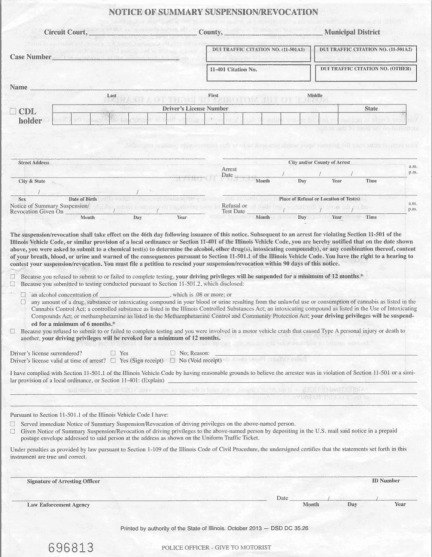
Example of a Law Enforcement Sworn Report — bring this to your evaluation appointment.
- Valid Photo ID: Driver's license (even if suspended), state ID, or passport.
- Court-Purpose Driving Abstract: This is your official driving record from the Illinois Secretary of State. You can order it online at cyberdriveillinois.com or get it in person at a Secretary of State facility. Cost is usually around $20.
If you don't have your arrest paperwork, you can get a copy from your attorney (if you have one) or the Circuit Clerk's office in the county where you were arrested. If you're not sure what you need, call ahead — we're happy to walk you through it at (217) 891-6063.
What Questions Will They Ask?
The questions in a DUI evaluation might feel personal, but they're standardized and required by Illinois law. The evaluator isn't there to judge you — they're gathering information to make an accurate assessment.
Typical Questions Include:
About Your Arrest:
- What happened the night you were arrested?
- What was your blood alcohol level (BAC)?
- Have you had prior DUIs or alcohol-related incidents?
About Alcohol and Drug Use:
- How often do you drink alcohol?
- When did you start drinking?
- Have you ever tried to cut back or quit?
- Have you used any drugs (legal or illegal)?
About Your Health and Situation:
- Do you have any medical or mental health conditions?
- Are you currently employed? Living situation stable?
- Does anyone in your family have a history of substance use?
The evaluator will also review your driving abstract and arrest documents to get a full picture of your situation.
Should You Be Honest?
Yes. Absolutely.
This is one of the most common questions we hear, and the answer is simple: honesty is essential. The evaluator is a trained professional who's conducted hundreds or thousands of these assessments. Minimizing your drinking, lying about past use, or trying to "game" the evaluation doesn't help you — it can actually backfire.
Here's why honesty matters:
- The evaluator has your arrest report, driving abstract, and BAC results. If your story doesn't match the facts, it raises red flags.
- Courts and the Secretary of State value accurate evaluations. If you're dishonest and later test positive or get another offense, it can result in harsher penalties.
- The goal isn't to "pass" — it's to get the right recommendation for your situation. If you need help, the evaluation is the first step toward getting it.
Remember: the evaluator is there to assess your situation, not to punish you. Being straightforward and cooperative makes the process smoother.
Can You "Fail" a DUI Evaluation?
No. You cannot fail a DUI evaluation.
The evaluation determines what level of education or treatment is appropriate based on your situation. Some people will be recommended for a 10-hour Risk Education class, others for an Early Intervention program, and some for outpatient treatment. The recommendation depends on factors like:
- Your BAC at the time of arrest
- Prior DUI offenses or substance-related incidents
- Your self-reported drinking patterns
- Any indicators of dependence or risky behavior
Even if you're recommended for treatment, that's not a "failure" — it's the system working as designed to address the issue and help you move forward.
What Happens After the Evaluation?
Once your evaluation is complete, you'll receive written documentation of the results. At DUI Evaluation & Treatment Services, we provide this the same day — no waiting around for weeks.
You'll then:
- Give the evaluation to your attorney (if you have one). They'll use it to negotiate with the prosecutor or present to the court.
- Complete any required education or treatment. If you're recommended for a Risk Education class or treatment program, you'll need to enroll and finish it before your case is resolved.
- Attend court hearings as scheduled. Your completed evaluation and treatment will be part of your case record.
- Apply for license reinstatement (if applicable). The Secretary of State will require proof of your completed evaluation and treatment for reinstatement hearings.
The sooner you complete your evaluation, the sooner you can start checking off the other requirements and move toward resolving your case.
In-Person vs. Virtual Evaluations
Illinois law now allows DUI evaluations to be completed virtually via telehealth. At DUI Evaluation & Treatment Services, we offer both in-person and virtual evaluations — whichever works better for your schedule.
Virtual evaluations are ideal if you:
- Live outside the Springfield area
- Have transportation challenges
- Prefer the convenience of completing it from home
- Live out of state but have an Illinois DUI hold
Virtual evaluations are just as valid and accepted by Illinois courts and the Secretary of State. Learn more about our virtual evaluation options.
Tips for a Smooth Evaluation
To make your evaluation as straightforward as possible:
- Bring all required documents. Missing paperwork means delays.
- Arrive on time. We respect your schedule and ask that you respect ours.
- Be honest and cooperative. The evaluator is there to help, not judge.
- Ask questions if you're unsure. We're here to guide you through the process.
- Follow up quickly. If you're recommended for treatment, enroll as soon as possible to stay ahead of court deadlines.
Ready to Get This Done?
A DUI evaluation might feel intimidating, but it's a straightforward process — and getting it completed early gives you one less thing to worry about as your case moves forward.
At DUI Evaluation & Treatment Services, we've been helping people navigate the Illinois DUI system for 15 years. We're trusted by Sangamon County's top DUI defense attorneys, and we're here to make the evaluation process as simple and stress-free as possible.
Call us today at (217) 891-6063 to schedule your evaluation. In-person or virtual — your choice.